Club Excem
Table of contents
The Club Excem is a part of our web site dedicated to the circulation of technical information, technical papers picked out of our
bibliography, and free software. Do not hesitate to e-mail your comments.
Two types of electrical links for signal transmission are well known to electronic designers: single-ended links (in which a single conductor is allocated to each transmission channel, the return currents flowing through a "reference conductor" or "ground conductor"), and differential links (in which two conductors are allocated to each transmission channel). We have worked to improve the signal integrity characteristics of electrical links, including the introduction of new signaling techniques. We present 28 papers of our bibliography and 26 patent applications in this area. We have sorted them into 5 themes:
Wireless transmitters and receivers may use several antennas simultaneously, in the same frequency band, to implement spatial diversity, beamforming, interference cancellation, or spatial multiplexing (MIMO). Traditional design techniques usually ignore the interactions between the antennas. We have investigated new circuits for the front-end of radio transmitters and receivers, which take these interactions into account. We present 15 papers of our bibliography relating to this research, sorted into 2 topics:
We first present a communication which discusses possible approaches for addressing electromagnetic compatibility (EMC) requirements in a project.
We also put 25 other technical documents at the disposal of the visitors of the Club Excem. They invite to a deeper investigation of EMC questions, and describe some useful techniques. They were selected from our bibliography. We have sorted them into 5 subject-matters:
Our on-line museum presents a few beautiful transistor radio receivers, covering the period 1968 to 1978. In those days, radio receivers were delivered with their schematic diagram, in order to make repair possible.
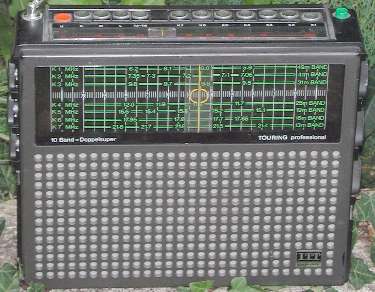
Receiver ITT Schaub-Lorenz
Touring professional 107
|
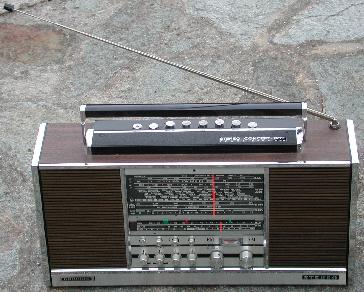
Receiver Grundig
Stereo Concert Boy transistor 4000
|
These schematics allow to assess the technical evolution during this period:
- the schematic diagram of the Grundig Europa Boy 208 receiver of 1968 uses silicon and germanium bipolar transistors,
- the schematic diagram of the Grundig Stereo Concert Boy transistor 4000 visible on the above picture, which is a more luxurious model manufactured at that time (thanks to Maurice for sending this schematic diagram),
- the schematic diagram of the ITT Schaub-Lorenz Touring professional 107 receiver (1973) shows a dual frequency conversion for the 7 short wave ranges and uses bipolar transistors and two integrated circuits,
- the schematic diagram of the Grundig Satellit 2400 professional receiver (1978), implementing also a dual frequency conversion and a digital frequency readout, shows that it uses bipolar transistors, 1 FET, 2 dual gate MOSFETs, and of course integrated circuits.
You are aware of the existence of the "EMC directive" (Directive 89/336/EEC of 3 May 1989), applicable in Europe since 1 January 1992. A "Revised EMC directive" (Directive 2004/108/EC of 15 December 2004) was published in the OJEU of 31 December 2004. It therefore entered into force on 20 January 2005 and the directive 89/336/EEC was repealed on 20 July 2007. We invite you to peruse the directive 2004/108/EC, using the
English edition or the
French edition.
The Revised EMC directive is the result of a process launched by the European Commission. Excem contributed to this effort when it performed a contract for the European Commission during the year 2000, concerning a "technical support to the activities carried out within the context of a possible revision of the EMC Directive".
The Revised EMC directive contains significant changes. One will for instance note that according to its Article 7 and to the paragraph 1 of its Annex II, manufacturers are entitled to deviate from harmonized standards, provided they can demonstrate that they comply with the protection requirements set out in the Annex I of the directive. These changes are covered in four articles of Excem:
|
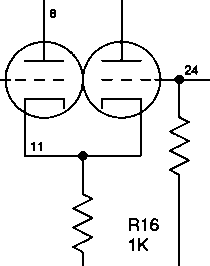
This section on the creation of electron tube models for the simulation of circuits with a SPICE simulation software contains two items:
|
 |